Get Real: Why the Way We're Parenting Is Stealing Our Kids' Purpose
Sep 01, 2026
Parents, you believe your parenting determines your child's success in life. I totally, totally get it — I used to think this too. Oh my gosh, what a waste of time and energy. Can we all just collectively take a breath in and let that go?
Prefer to listen? Watch on YouTube → or listen to the podcast →
I feel it every single day. And I know I'm in this conversation all the time, so I know you feel it too. It's how we're made to feel — like it's all on us. We think these things that are crazy, like, oh, they'll suffer if we don't get it right. Like we have this one shot to get it right when it comes to our parenting, and if we don't get it right, it's all going to go downhill.
And you know, there's things we think about. We think about the world being so big and scary and we want to protect them. I get that. I've been there and felt every feeling around that. But there's so many things about the pressure we put on ourselves that are not logical and don't make any sense. We have this nostalgia — our kids, they're little and we love them and we remember them as babies, and it's all just so deep and meaningful. It's wired right into your DNA, right, to keep them safe and protect them.
You don't want them to experience anything scary. You don't want them to have any discomfort. They live these frictionless, comfortable lives with no pressure — because it's all on you. And you agree with them because you want them to be happy, and you want them to feel supported, like you're their friend. You don't want to be disliked.
Ultimately, we have this narrative going on that we feel like we just can't win. And parenting is such a slog. There's so much pressure. And it depends on your perspective — so much of raising them, providing for them, and taking care of them has given you purpose and meaning, and that's where you're at right now. You keep going. You keep wanting to show up and do these great things to support your children, because it's giving you purpose.
Now here's the interesting thing: what if I told you that if you keep going like this, it will steal theirs?
The Drop Off
When you put that kind of pressure on yourself — that raising them and supporting them and finding the success in life you dream of for them is on you, and it's not shared, not with them — you're actually stealing their purpose. Because they get to have agency in this too.
I want to tell you about what goes on in my world. I'm a student success coach. I work with young people — teenagers all the way through college and into adulthood and launching into their careers. And I call it the drop off. Some parents, as soon as I say it, say it back to me: "Oh yeah, the burnout."
I don't think that when you have young children, you realize how exhausting it is to be the one who does all the things for their kids, all the time — guiding them, supporting them, all of it. There is a massive drop-off that I'm noticing, and I can report with confidence that it happens between the ages of 12 and 16.
You've got parents with young, pre-adolescent children doing everything to make sure there's this frictionless, beautiful experience of childhood. But as kids creep closer to age 10, 11, 12, they start to have their own opinions, their own ideas, their own friends. They socialize, start making plans, wanting different things. They start to individuate away from the parents.
And guess what happens? There starts to be this misalignment — in direction, in values. And I can tell you without a doubt: if these things aren't set right and put back on course between 12 and 16, the burnout is real.
I call it the drop off because at one point I'll be having this conversation with parents when the kids are young, and they're in it — they've got the energy, they're not tired enough yet, and it's all good. Then suddenly it's like, "No, you know what, I've had enough. They'll figure it out." The hands just get thrown up in the air. They'll figure it out. They've got to figure it out.
A lot of parents don't see it coming. And a lot of parents, when I'm talking with them, I get very excited if it's a parent with young children — that pre-12, 10-to-12 window — because everything about their world of parenting has been a certain way. They've been the leader and their child has been following along. It's been beautiful. And then suddenly things shift. Kids start breaking free, having their own ideas about things — and this is where it all falls apart.
Parents try to stay in it. They feel like they have to fight, like they have to take that leadership role back, because that makes them a good parent. And they never see it coming — that this will shift and possibly rip and alter the relationship in ways they never saw. I see it over and over and over again.
Time to Get Real
And what I like to say to parents, and what I'm sharing with you today, is something actually groundbreaking, earth-shattering. It shifts the whole paradigm and perspective. And that is: it's time to get real. Get real with ourselves, get real with our kids, share the responsibility, share the journey, and change the game — change the energy around what's actually happening here.
What are you really fighting about? How things are done, who's doing what, where you're going, what you're doing, who you're with. It starts to shift and change and you've got to figure it out. When you're sharing the journey, the energy is just different. And the kids actually have the opportunity to rise to the occasion.
This has proven itself to me time and time again: the parent's ability to get real with themselves about their role changes what the parenting role demands — not from society, but from the parent, and from the young person. We need to have this conversation much earlier than people think. I'm having these conversations with parents of 16, 17, 18, 20, 28-year-olds, saying, "Well, when are they going to take the responsibility?" There has to be a stepping up, a graduation — of that intensity, that responsibility, all of it.
What's interesting is once you see it, you can't unsee it. I'm really pumped about introducing the idea that you get real with your kids and share that growing-up experience. Make sure they have agency in the decisions and choices being made, because they need practice. That 12-to-16 window is the junior-adulting age range. And a lot of parents feel like they can make the decisions for their kids, and they don't let their kids practice.
The 2 + 2 Story
It's kind of funny — I reflect on an experience I had when my kids were really little. We were at a friend's house whose kids were just a couple years older than mine. Their child was in grade one, doing math homework. Every time the child was working on an addition question — like 2 plus 2 — the mom was having this anxiety, looking at her child and saying, "It's four. It's four. Say four."
It was like, what are you doing? They have to map it out. Help them, sure — but do it for them? They're never going to get it if they don't experience adding up. If they don't have the mechanics wired and fired in their brain, they're not going to actually know how to add. They're just going to know that when you say 2 plus 2, it's four. But do they know what that means? They just want to make you happy.
That's the kind of thing I'm talking about — except the stakes get higher. We're not talking about 2 plus 2 equals 4 anymore. We're talking about, hey, this is a scenario in play with your friends — what do you choose to do? Or, you're here and this is happening — what choice do you make? The adolescent years, that 12 to 16, is all practice ground.
And it's amazing how quickly parents will burn out and drop off and just say, "Oh, they'll figure it out." They throw their hands up, and their child is left kind of abandoned. You've been with them in this really deep, dirty way — caring about every single grade, every single assignment, every single mark, every single little thing — and then all of a sudden it's sink or swim. Figure it out.
We All Want the Same Thing
It's a very real concept, and at the same time, I think we all have the same desire. We want to see our children shine. We want to see them launch powerfully into adulthood and thrive. And I feel like we don't realize that runway happens a lot earlier — the opportunity for it, and honestly, the necessity for it, isn't being experienced early enough.
Young people need this experience: okay, this is a choice, this is a situation I have to assess, I have to make decisions, I have to steer myself, guide myself, analyze things, take in the environment, weigh the options. And with parents, what I'm seeing is that there are so many out there who are so passionate — we love our kids so much, of course we do — and we really want to see them succeed.
If we want that, I promise you the real way to get there is to get real. Get clear on your role. Really clear on the goal. Look at your child. Spend time with your child and try to imagine: what does it look like for them at 18, 20, 22, 25 — really up to something in life and really getting after it? I'm pretty sure it's going to be some version of their agency and autonomy in steering themselves, guiding themselves, having the wherewithal to figure it out powerfully — not from a disempowered state of reactivity and feeling alone in it.
We've got to get really clear on our role, really clear on the goal — the vision we hold for our kids, what those years, 12 to 16 and up, can look like. Why 16? Because if you go meet a 16-year-old and have a conversation, they're already in their own world. They're their own person wholly. Sure, you're their parent, but that's a fully formed, autonomous individual on the cusp of adulthood — learning to drive, learning it all, with real independence.
And that conversation — hey, what's going on in your world, what do you care about, what's your next move after high school — a lot of kids feel so much pressure by age 16, and they don't really know the world, because their parents have been navigating the world for them. It's a whole thing.
Getting Real With Myself
I'm really excited to be having this conversation about getting real, because that language and messaging is so integral to everything I do. This window — these four years between 12 and 16 — is where it all shifts. I truly believe that. And getting real with yourself about your role as a parent — it's that make-or-break for how they launch.
I don't love making this joke, but I make it all the time, because it's very real and present in my life: parents of 20, 22, 25, 28, 30, even 38-year-olds are telling me their kids are at home living in their house, not participating in the world — not working, not in education, not getting after something. They feel disempowered and directionless. It's a real, growing concern.
So that's why I'm here jumping on, wanting to have this conversation with you. I'm doing something about it. Being in this conversation is totally my jam — I don't know if you can feel it, but I get very fired up and I love it. And I want you to be in this conversation with me.
Still the Digital Reset Mom
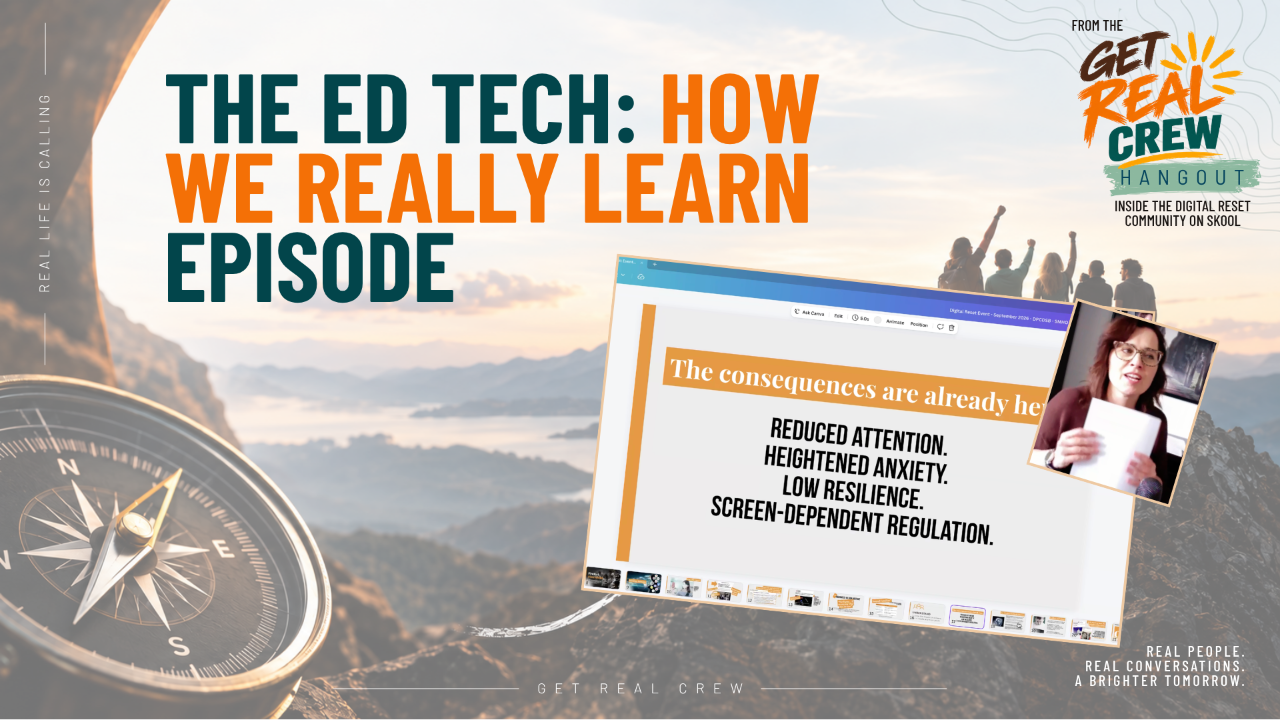
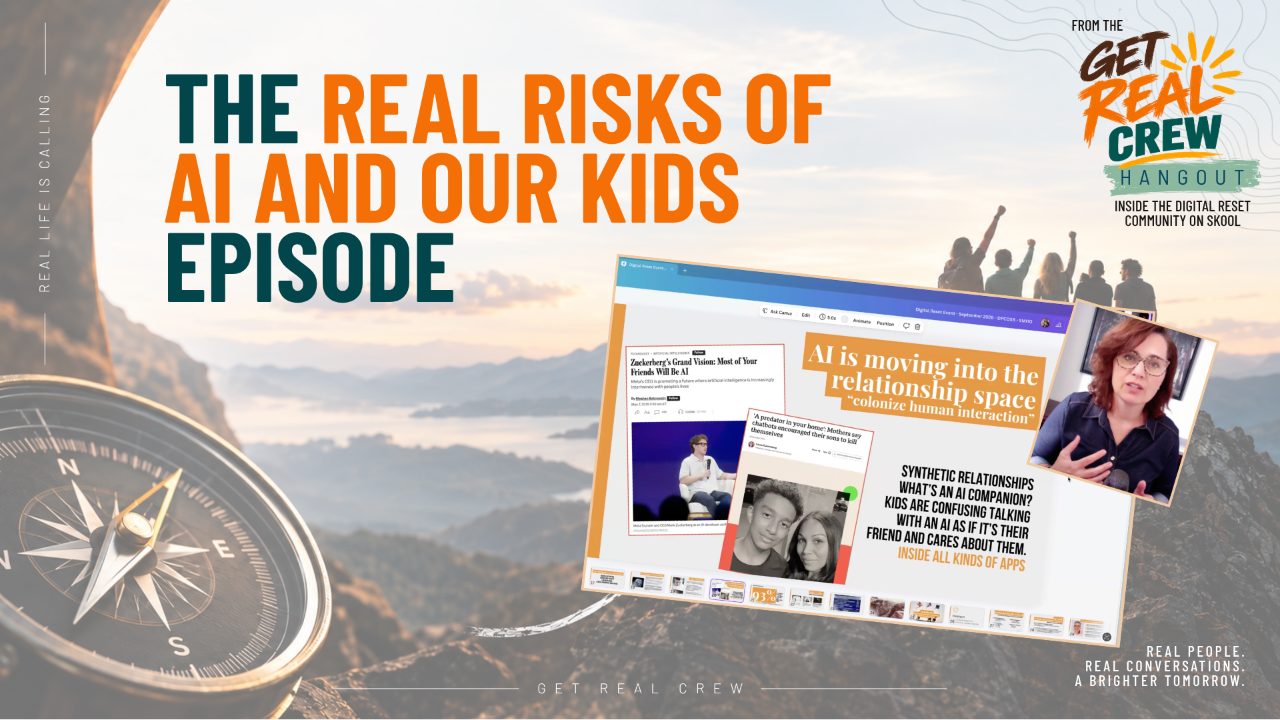
If you're already in my world, you know I'm the digital reset mom. I talk digital reset, I won't stop. And I'm still her — still the digital reset mom. The reason why is because that's the biggest thing in the way right now. The biggest obstacle on that journey to our kids launching powerfully into life is the role technology plays in their lives. The cell phones, the social media, the AI, even edtech — there is constant technology in the hands of our children, and it's steering them away from what this powerful launch into adulthood could be.
It's really the thing, the obstacle, that's in the way. So I will forever be the digital reset mom, showing up to talk with parents about how we take our power back, and how we commit to a powerful growing-up experience for our kids. I truly believe technology, the screens, are stealing our kids' opportunities to develop the skills they need for this to actually take place.
So I'll always be the digital reset mom — but the layer I'm adding on top of all of this is: I'm the get real mom. That is truly at the heart of this. If I cast my mind back to the beginning, I have always been that mom who says, "Hey, why would I do this for my kids?" You can ask my kids — I have a 17- and 19-year-old now, and I don't do much for them, proudly, because guess what — they do it all themselves. They are self-sufficient, self-reliant, self-directed people that I'm so proud of.
It's worked out so far — that this is what it is for me. I'm not saying it's perfect. This is just where I'm at. So far, this strategy is working out. That's all I can report.
Join the Conversation
So I'm looking for teammates. I'm looking for fellow get real parents. I'm building this community — the Digital Reset Community — because that's the thing that's in the way. But we're calling ourselves the Get Real Crew, and we meet every week on Wednesdays.
Here's how it works: the Digital Reset Community is free to join. If you resonate with anything I've said here, come get real with me. From there, you have the option to upgrade to Premium or VIP — VIP includes a private 1:1 call with me — and those upgraded tiers are where you get to jump into our weekly live hangouts, the Get Real Crew Hangouts.
And if you want to go deeper, the Total Digital Reset course is available as an add-on, currently $9.
I hope you'll consider it. Come into our world, come into this conversation. This get real thing — we need to support each other. We need to have each other. We need to be in this powerful conversation that helps our kids. We have to take our power back with the digital stuff. We're taking our time back. We lose so much time to the screens, and we lose the opportunities for developing real-world connection, motivation, direction, and inspiration. Our kids are kind of checked out — ask them what they care about in the world, and it's very hard for them to put their finger on it.
That's my world. That's the conversation I live and breathe every single day. I love young people. I show up for them first. Number one, I'm here for a get real childhood. And that is why I'm unapologetic about what it takes for us to get there.
I think we need to change our definition of what it is to be a really great parent. And at a certain age, it stops being so much about you and starts being a lot more about your kids. That's what we're getting real about, and supporting each other in.
Thank you for being here. Thank you for reading. I look forward to seeing you again soon.