The Ed Tech How We Really Learn Episode
Oct 07, 2026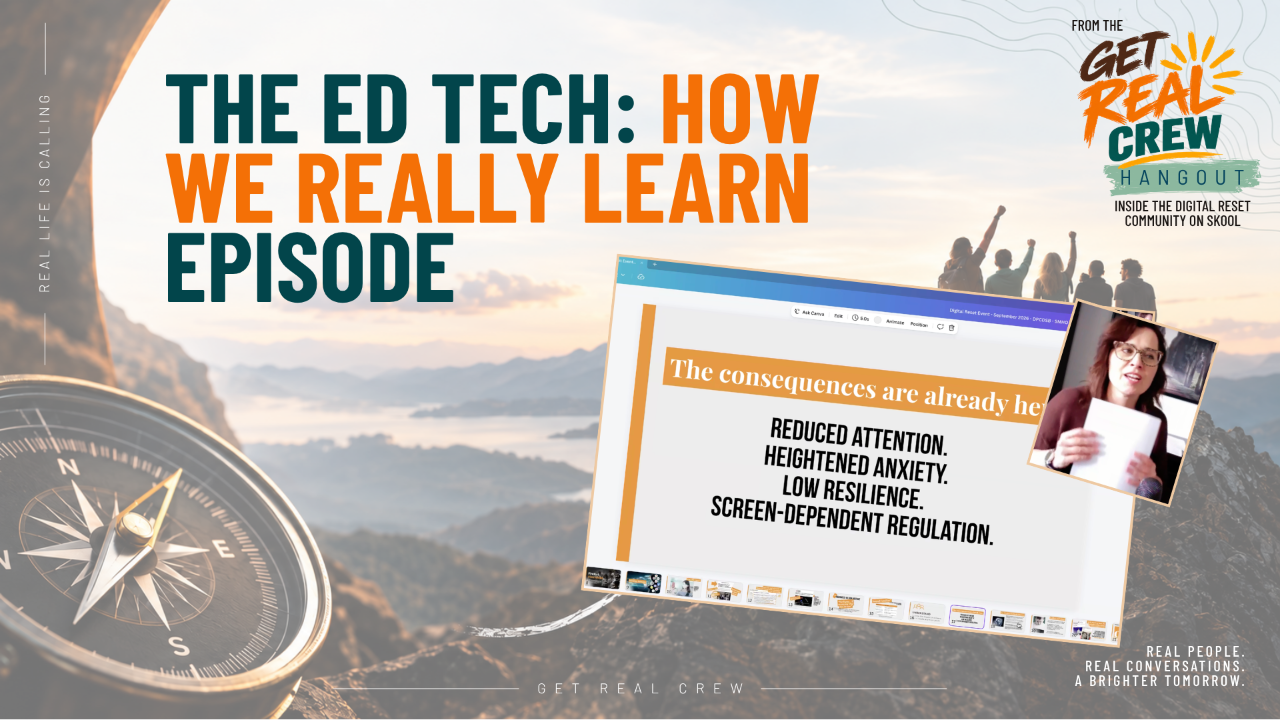
For years, I trusted the experts. When my kids' schools got into tablets and laptops, I assumed educators and school boards had done the homework and it all seemed really modern and sophisticated. Technology was the future, right?
Then, around 2015, I noticed something at home. My kids, who used to love reading, were loosing focus and not interested in paying attention for long when we read together. At about the same time research started showing a sharp rise in suicide rates among young girls who were using Instagram and that essentially got me to sit up and pay more attention. That was my wake-up call.
I started asking questions. What I found changed how I think about technology in the classroom.
What the research shows
For more than a century, every generation outperformed the one before it. Kids spent more time in school, and they got sharper.
Then something changed. Dr. Jared Cooney Horvath, a neuroscientist and former teacher, told the U.S. Senate in January 2026 that Gen Z is the first generation to score lower than their parents on core thinking skills, even though they've spent more years in school. The turning point he points to is around 2010, when digital technology spread through classrooms.
And it isn't just one country. Across about 80 countries, the pattern holds: the more students use computers in class, the lower they score in reading, math and science.
Here's the line that stopped me in my tracks. Human beings learn best from other human beings. Not from screens.
What teachers are seeing
When schools gave every student a tablet or Chromebook, the promise was better learning. The results tell a different story.
Teachers tell me the same thing again and again. It's harder than ever to keep kids focused. Lessons need more entertainment and quicker soundbites just to hold attention. And when attention gets shorter, deep learning and critical thinking suffer.
We're seeing kids with less focus, less resilience and more reliance on screens to manage their emotions. This isn't a future problem. It's in our classrooms right now.
Why pencil and paper still win
Many of us assume technology is the next step up. Typing feels faster and more advanced, so it must be better. For learning, the research points the other way.
Researchers in Norway measured brain activity while people wrote by hand and while they typed. Handwriting lit up far more connections across the brain, the kind linked to memory and learning. The lead researcher also noted that children who learn letters on a tablet can struggle to tell mirror-image letters like "b" and "d" apart. They've never felt the shape of the letter in their hand.
As a former music teacher, this makes complete sense to me. You don't learn an instrument by watching someone play. You learn it through your hands, slowly, with practice. Learning to read, write and think works the same way.
The countries pulling back
Some of the most tech-forward countries in the world went all in on classroom technology. Now they're reversing course.
Denmark was a pioneer, bringing tablets into schools starting in 2011. A former Danish education minister has said she believes tablets played a role in falling reading and math skills. Today, Denmark is banning phones and personal tablets in schools and investing hundreds of millions in printed books.
Sweden saw that about a quarter of its students struggled to read properly. Its government launched a "from screen to binder" policy and has spent over two billion kronor bringing back textbooks and handwriting.
When the early adopters hit the brakes, we should be paying attention.
Parents are asking
Who is Dr. Jared Cooney Horvath?
He's a neuroscientist, educator and former teacher who studies how people learn. He's the author of The Digital Delusion: How Classroom Technology Harms Our Kids' Learning, and in January 2026 he testified before the U.S. Senate about the decline in student thinking skills.
Watch Dr. Horvath explain his research:
https://youtu.be/Fd-_VDYit3U?si=mnN2qMEwewtcbgp1
How does screen time change attention, and what are the signs?
Fast, constant stimulation trains the brain to expect quick rewards, so slower tasks start to feel unbearable. Watch for a child who can't finish a book or homework without drifting, needs background noise or video to work, gets bored within minutes, or jumps between tasks without finishing any.
How can parents help with screen dependence?
When a screen does the calming, kids never build that skill themselves. Start small. Replace one screen moment a day with something calming you do together, like a walk, a snack and a chat, or music. Name the feeling out loud, and let them practise riding it out. Encourage reading on paper and writing by hand at home.
What helps children build resilience?
Resilience grows through small struggles. Let them be bored. Let them figure things out before you jump in. Give them chores, real responsibility, outdoor play and time with people face to face. Every challenge they work through on their own makes them stronger.
Choose your next step
Wherever you are on this journey, there's a place to keep going. Pick the one that fits you best.
If you're ready to make real changes at home... The Total Digital Reset Course walks you step by step through understanding the problem, protecting your kids and resetting your family's relationship with screens. It's the clearest path from worried to confident. [Start the Total Digital Reset]
If you want support from parents who get it... Join the Digital Reset Community, where parents share what's working, ask questions and cheer each other on. You don't have to figure this out by yourself. [Join the community]
If you want your school, parent council or workplace to hear this... I bring the Screen Time Reset presentation to schools, parent councils and organizations. It gives parents and staff the full picture and practical tools they can use right away. [Book me to speak]
If your child needs help finding their spark offline... ShineOn Student Success Coaching helps young people build a strong sense of who they are and what they care about, so screens have less pull. [Learn about coaching]
Hope to see you live next week!
Let's get real together,
Lucy
Lucy Colangelo, the "Get Real" Digital Reset Mom 25-year marketing insider turned digital parenting advocate and creator of the Total Digital Reset. shineonmethod.com
Sources: